
12 Feb 2026
Phase Split Detection
When two liquids that don’t mix settle in a vessel, they form layers: an organic phase, an aqueous phase and usually a band of emulsion between them. To separate them, the vessel is drained from the bottom, and the valve has to close, or the flow switch to another destination, the moment the interface arrives. Close too early and good product stays behind. Close too late and the wrong phase or the emulsion goes on to the next step.
Phase splits come up in solvent extraction and washing steps in pharmaceutical, bioprocess and chemical plants. Often the split is still judged by an operator watching a sight glass, which ties up a person for every batch and depends on what they can see.
Watching the interface with a camera
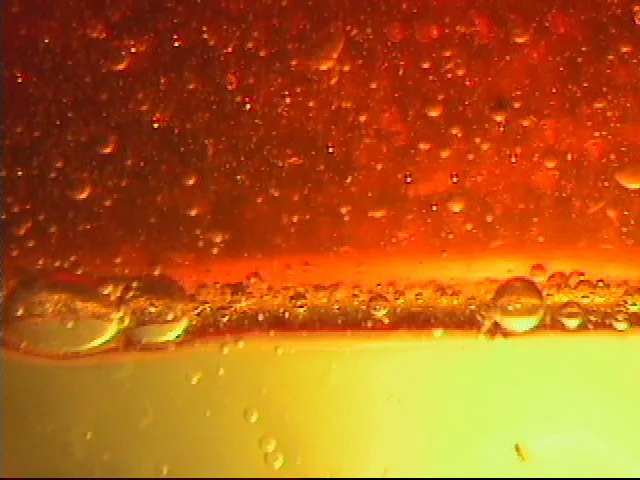
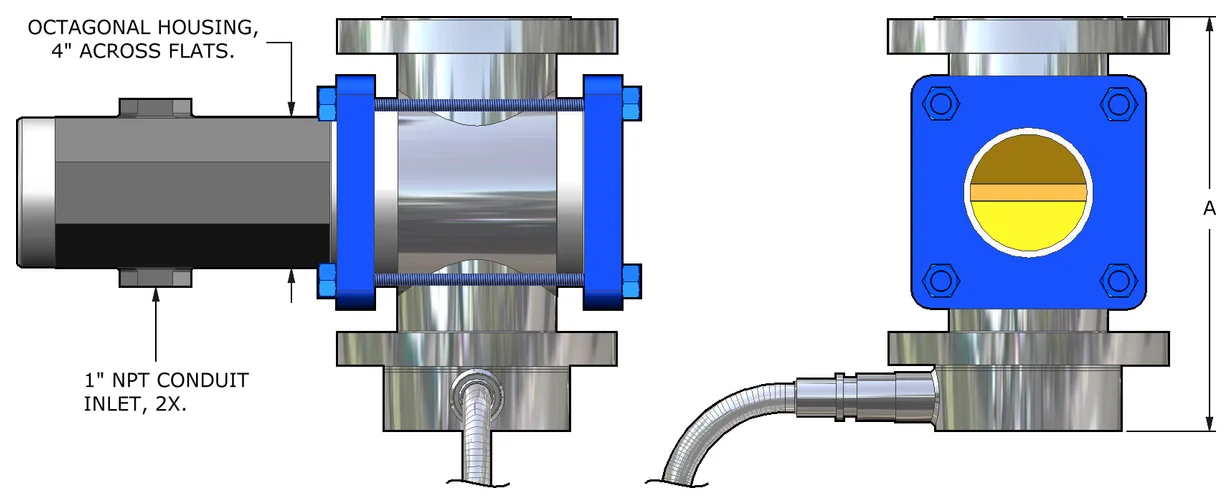
Canty’s phase split system puts a camera and a light on a flanged sight-flow body in the vessel’s drain line. Operators see a live image of the liquid in the line from the control room, and the system can detect the change itself:
- It tells all three phases apart: the organic liquid, the aqueous liquid and the emulsion of the two.
- From start-up it watches the emulsion and signals when the phase changes, so emulsion doesn’t flow to the wrong place.
- Once the phases have separated, it allows tight control of the split, so more of each liquid ends up where it should.
- It is non-contact: nothing sits in the flow, so there is no sensor to foul or coat.
- It suits both batch and continuous processes.
Software, signals and records
With Canty’s CantyVisionClient™ software, the system does more than show a picture. It checks the colour of the liquid and the level and colour of each phase, and sends an output signal at set points of the interface. The control system can use that signal to close the valve or switch the destination. Every measurement can be recorded and archived, giving a history of each split, which helps where batch records matter.
The cameras use Gigabit Ethernet, so production, quality and engineering can all watch the same live image from their own networked PCs. Extra monitors can be added for local viewing.
The light makes the image
A clear image depends on good lighting. Canty brings cool light into the line through fibre-optic light guides, designed to get as much light as possible into the flow. Because the light is cool, product doesn’t bake onto the viewing window.
Options
The system is built to order for the line it goes on. The sight-flow body comes from Canty’s flanged sight flow range.
- Line size: 2, 3, 4, 6 or 8 in ANSI flanges (Class 150 or 300), or DN50 to DN200 DIN flanges
- Pressure rating: 150 psi / 10 bar, or 300 psi / 16 bar
- Wetted metal: 316 stainless steel, Hastelloy® C276 or Hastelloy® C-22, with a PTFE-lined version also listed
- Gaskets: Viton®, Buna, EPDM or silicone
- Camera: Gigabit Ethernet colour, 640 × 480 or 1620 × 1220 pixels
- Enclosure: NEMA 4 / IP66 weatherproof, or explosion-proof (US) / flameproof (Europe) for hazardous areas
- Power: 120 V AC 60 Hz or 230 V AC 50 Hz; Canty supplies the transformer to 12 V DC
Contact us with the liquids, the line size, the process pressure and temperature, and the area classification, and we’ll configure the system with Canty. See also the process camera for viewing inside the vessel itself, and the instruments for bioprocessing & process skids.
Downloads
Source: J.M. Canty, Phase Split data sheet (TA9788-1 Rev. 5). Interface image and drawing courtesy of J.M. Canty.